
A typical scene in an apartment building: the building has been renovated from the facade to the heating system, yet the bicycle still stands in the apartment hallway because nobody dares to leave it in the basement. In many buildings the basement is the most poorly used space: the floor area is there, but nobody wants to use it.
When the association finally decides to put the basement in order, the conversation usually jumps straight to the storage units: how many are needed and how much they will cost. Since 2006, Optiman Ehitus has built more than 400 basement storage units; in 2025 alone, apartment associations ordered 138 of them. Our experience says that the storage units are the last step in putting a basement in order, not the first. First, the room where the units will go has to be put in order.
What you find in an old basement
Many basements are still in the condition they were in when the building was built. The wooden storage units are worn out, the doors no longer lock, and some units are filled with ownerless belongings because the apartment owners changed long ago. The corridors are narrow, the lighting is poor and the air is stale. Moisture comes from the structures, the ground or inadequate ventilation. Often from several places at once.
Such a space has two costs for the association. The first is unused floor area: residents keep their things in apartments and stairwells, where they get in everyone’s way. The second is liability. Escape routes must be clear and usable, and combustible material must not be stored in a way that obstructs evacuation or hinders rescue work. Which basement corridors count as escape routes depends on the specific building. But a basement full of clutter is in any case a matter for the board, not just a question of cleaning.
First the room, then the storage units
A metal storage unit with mesh walls is a good product. But it does not fix the room it is placed in. The mesh lets air and light through, but it does not dry out a damp basement. If new units are installed in a damp basement, the very things people want to store there will start collecting moisture and going mouldy.
That is why three questions have to be answered first.
- Is moisture a problem, and how can it be stopped?
- Is there enough air and light?
- What condition are the floor, walls and ceiling that the new structures will be attached to in?
The answers define the actual scope of work. The only remedy for moisture is to eliminate its source, whether it lies in the structures, the ground or the ventilation; a stuffy, dark basement needs air exchange and new lighting; crumbling walls and ceilings must be repaired and the floor levelled, because the frame of a storage unit has to be anchored to something solid.
Dried-out wooden partitions and ownerless belongings have to be hauled out before the new units are built. The storage units come last, into a room that has already been put in order. This is also the order our work process follows.
Which storage units suit a basement
Two main solutions are used: units with mesh walls and units with solid walls. Optiman builds both, and the choice is made based on the specific basement.
A mesh wall lets air circulate through the whole basement, so the space does not become stuffy and belongings do not go musty. Design guidelines also justify mesh walls on fire safety grounds: if something catches fire in the basement, a firefighter can locate the source through the mesh and get to it without breaking down locked doors. Without opening the door, you can also see if something has ended up in a unit that should not be there.
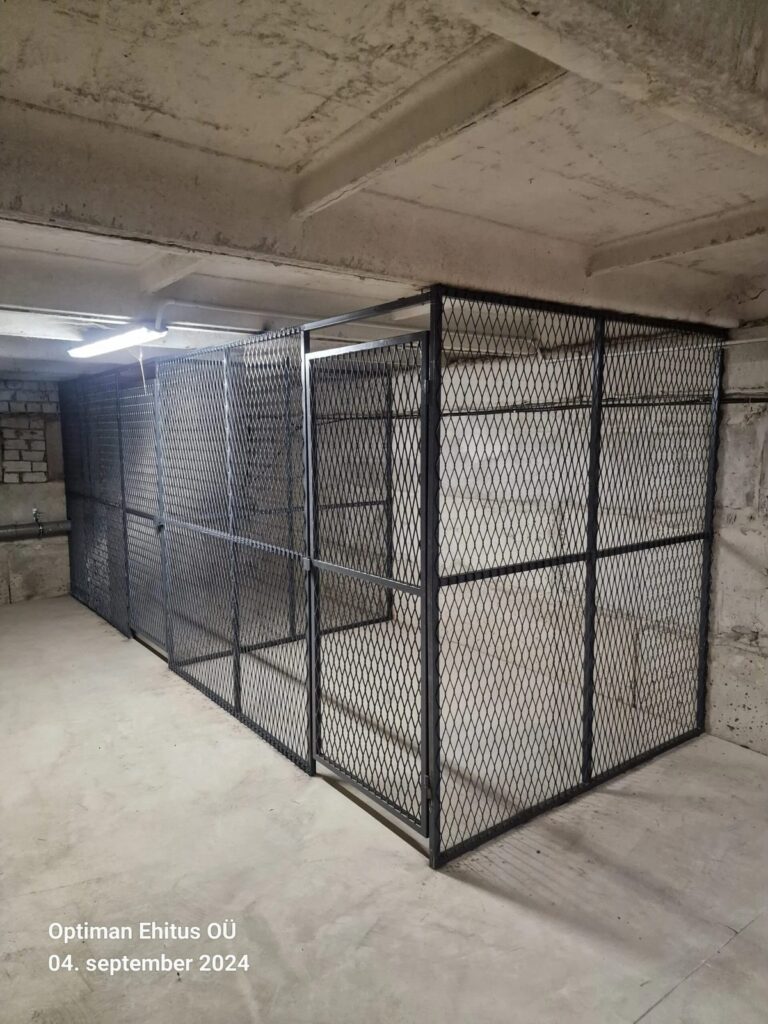
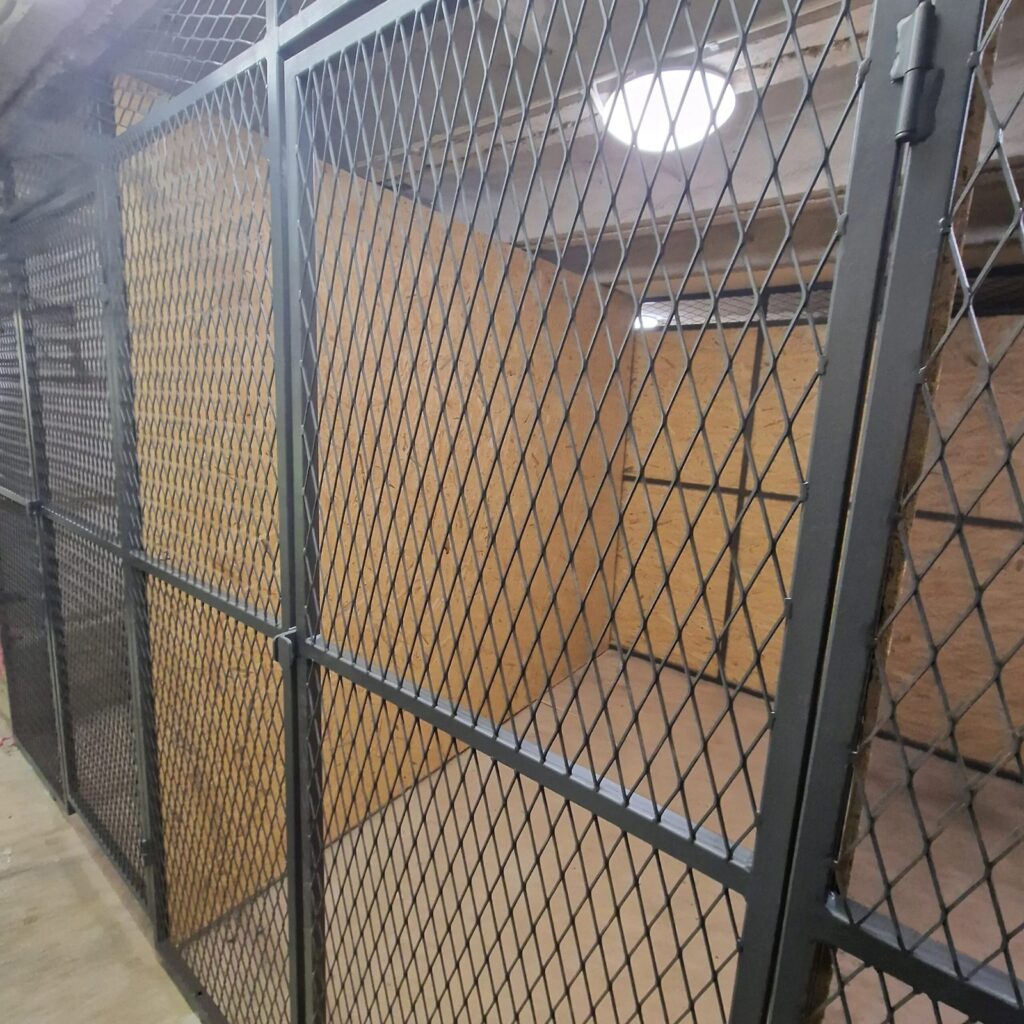
Our expanded metal mesh storage units are built on the same logic. Expanded metal is a stretched metal mesh: a panel cut from a single steel sheet and stretched open, not woven or welded wire. So it cannot be unravelled or easily cut through. Fixed to a steel frame, the mesh runs from floor to ceiling and also covers the opening above the door: you cannot get over or under the unit, but air moves freely. Still, mesh is not used everywhere. The side facing the corridor is mesh, because light and visibility are needed there. Between neighbouring units there is a solid partition.
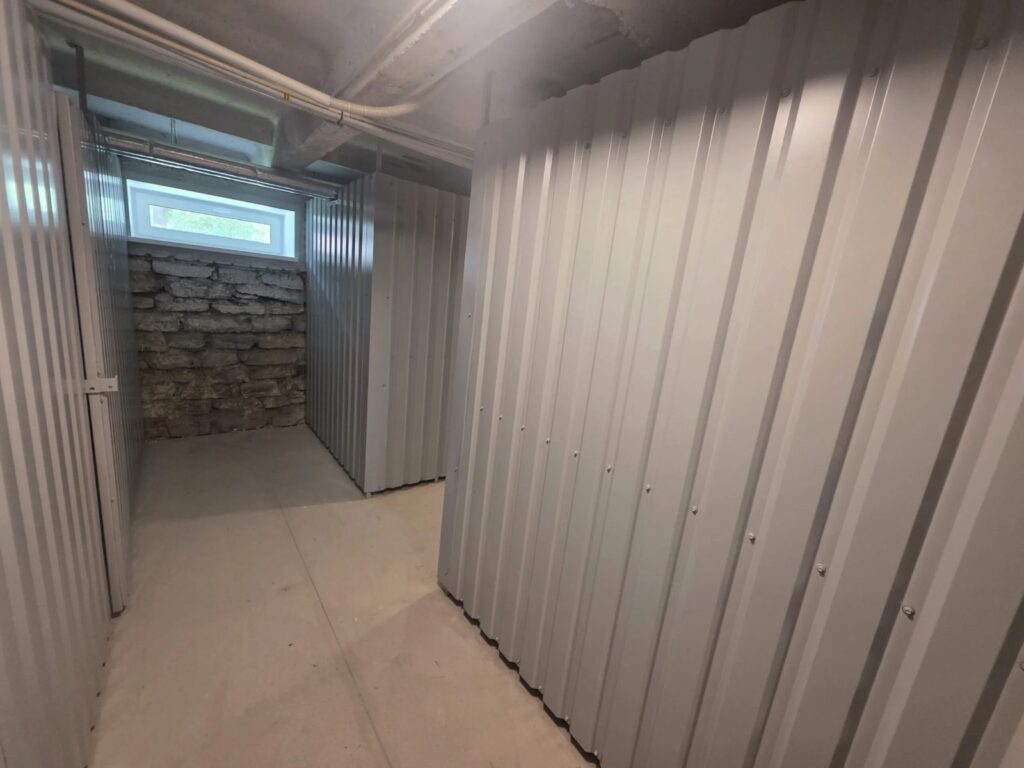
The other solution is a closed storage unit made of profiled sheet metal. Its advantage is privacy: nobody can see what is in the unit. Solid walls require the basement’s own ventilation to be in good order, since no air passes through the walls. So mesh suits a damp basement or one with poor air exchange, while in a dry basement with proper ventilation you can choose closed units if residents value privacy.
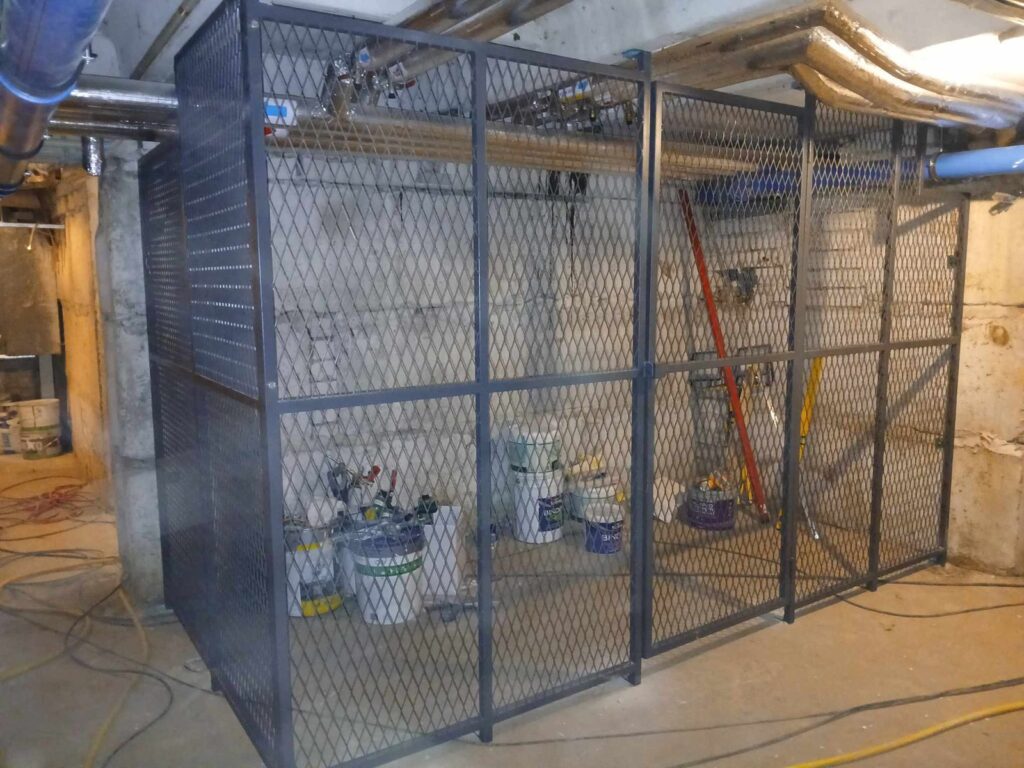
Both solutions are made to the dimensions of the basement. Cut-outs are made in the frames around pipes and beams, and valves and cleaning hatches remain accessible, so nobody’s storage unit has to be dismantled in an emergency. The units are made in Optiman’s metal workshop and installed on site. They are handed over with a padlock hasp, and each resident fits their own padlock.
One thing is worth pointing out here: no basement storage unit is a safe. A metal structure, a padlock, lighting and controlled access reduce the chance of opportunistic theft and make the space easier to monitor. But the advice of insurers and the police is unanimous: valuables do not belong in the basement. The basement is for tyres, bicycles and preserves.
What the board has to decide itself
Putting the basement in order is an expense on the scale of the repair fund and usually requires a decision by the general meeting. The decision is easier to reach if a quote has already been requested before the meeting. But the contractor cannot decide the following matters on behalf of the association.
Informing residents. Old storage units must be emptied before work begins, and going through the accumulated belongings takes families time. The earlier residents are informed, the more smoothly everything goes.
Ownerless belongings. Old basements always contain things whose owner can no longer be found. Agree on a procedure before work begins: a written notice to all residents, a reasonable deadline and documented removal.
Number of units and walkways. Usually every apartment gets its own storage space; a common rule of thumb is about one square metre of storage per resident. The aisle must be wide enough to move comfortably with boxes or a bicycle, and unit doors must not open into each other or into the walkway.
Numbering. It pays to number the units and link them to the list of apartments right at the start. That way there are no disputes later about who owns what.
Rules. Agree in writing what must not be kept in the units. Estonian fire safety requirements allow flammable liquids to be kept in an apartment building’s basement only in limited quantities (up to 5 litres per apartment), and firewood only if the basement has a separate fire compartment. Gas cylinders do not belong in the basement at all: gas is heavier than air and in the event of a leak collects at the lowest point of the room. E-bike batteries should only be charged under supervision and never on escape routes.
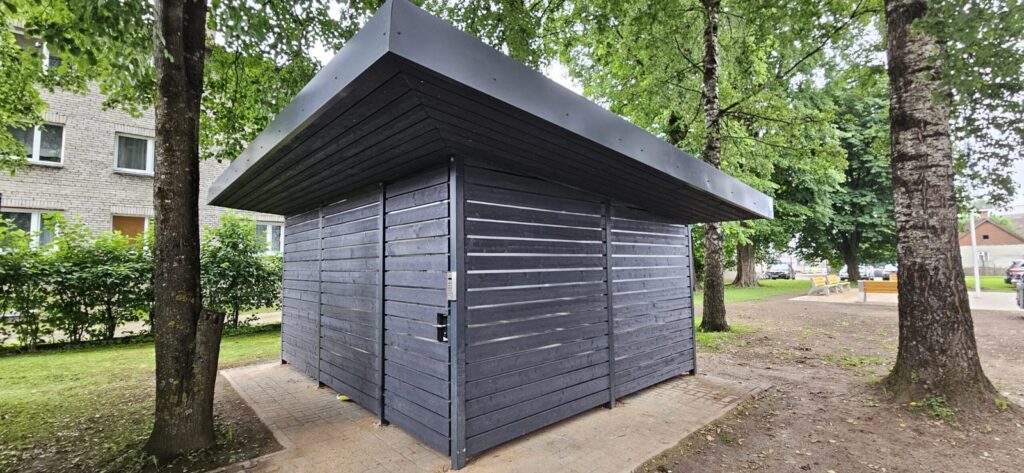
The yard. Bicycle and waste shelters for apartment building yards are made on the same production logic: a steel frame, mesh or boarding, and a roof. With a lockable bicycle shed, bikes no longer have to stand in the stairwell or hallway, and e-bike batteries can be charged more safely away from shared spaces. It makes sense to build the bicycle or waste shelter at the same time as the basement renovation.
Five questions before approving a quote
Quotes differ in content, not just in price. Before approving one, the board should ask:
- Does the contractor inspect the condition of the basement first, or just count the number of units?
- Does the price include demolition of the old units and removal of the debris?
- Is the work on the basement itself (moisture control, ventilation, floors and walls, lighting) listed separately in the quote?
- Is the deadline stated in the quote?
- What warranty applies to the work? Optiman gives a two-year warranty on all its work.
In conclusion
The effect of a renovated basement is felt every day: bicycles, tyres and preserves are in a locked storage unit, not in the apartment or the stairwell. The association knows the corridors are clear. If your building’s basement is waiting to be put in order, start with the condition of the room, not the number of storage units. To request a quote, a short email or phone call is enough. Let us know where the building is and what condition the basement is in.
About the author. Valeri Tuopi is the managing director of Optiman Ehitus OÜ. The company’s metal workshop in Kambja produces basement storage units, metal stairs, railings and handrails, fences and gates, and metal structures for bicycle and waste shelters.